
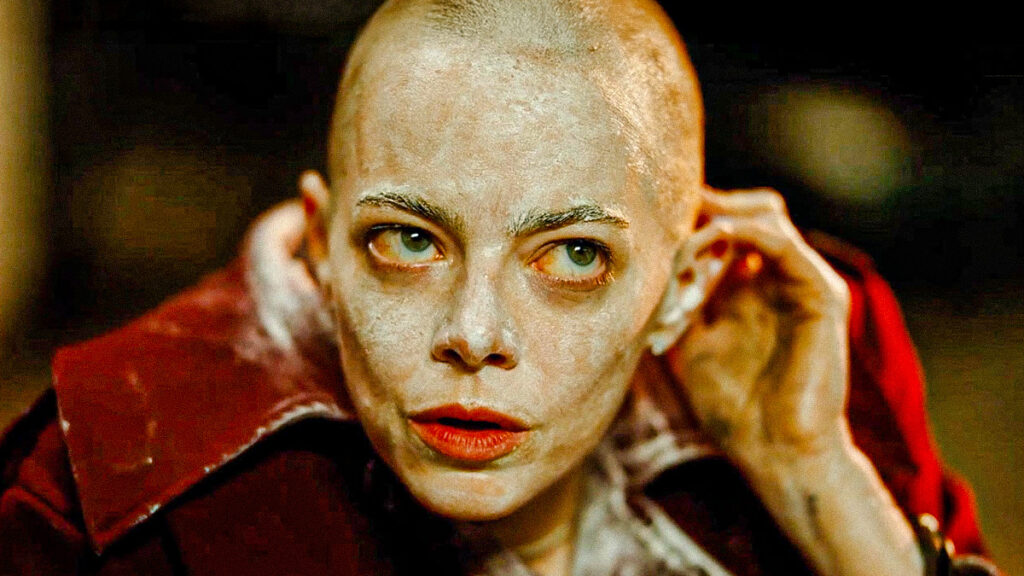
The room is wider than comfort allows. Fluorescents hum like a dare. Yorgos Lanthimos doesn’t push you into Bugonia so much as sit you down and refuse to blink; the camera’s calm feels like a lie everyone agrees to. In that calm, a pharmaceutical executive (Emma Stone) and a beekeeper-believer (Jesse Plemons) circle each other inside a theory that has already chosen its ending. This Bugonia review begins there, where reason and ritual share a table that feels too long to cross.
What lands first is the surface. VistaVision turns faces into evidence. Skin is glass, the air almost too clean, the table so long it looks punitive. Robbie Ryan’s lensing stretches the room until you start measuring the moral distance between people. Lanthimos has used immaculate frames before, but here the width feels like a tactic: when you can see everything, you’re forced to decide what you’re pretending not to see.
The sound makes that decision harder. Jerskin Fendrix doesn’t score scenes so much as aggravate them. A low mechanical drone arrives with the confidence of a fact; a sudden scrape interrupts a thought mid-forming. Then silence—the kind that makes you aware of your own breathing. Comedy flickers at the edges, but it’s the mean kind of funny: the belief that you, unlike the characters, are too smart to be fooled. The movie keeps testing that belief.
Stone plays Michelle with a stillness that reads as power until it reads as armor. There’s a micro-flinch when she realizes her captors don’t want information; they want proof of a story they already love. Plemons gives Teddy a tenderness that makes him scarier—the softness of someone who thinks he’s finally doing the right thing. He listens like a man at church. When he smiles, it isn’t comfort; it’s confirmation.
Lanthimos and writer Will Tracy stage certainty as labor. You watch the prep, the lists, the improvisations that make a theory feel like work worth finishing. The film’s title points toward an old myth about life springing from what’s dead; the story treats conspiracy the same way, a kind of wishful alchemy that turns fear into meaning. The beekeeping, the jargon, the ritual—all of it feels like a job performed for an employer no one has met.
There’s a stretch where you feel the screws tightening and then loosening and then tightening again. The basement exchanges hold a beat too long, not because the movie loses nerve, but because its rhythm flirts with monotony. That flirtation is the risk in such controlled filmmaking: the same steadiness that builds dread can flatten it. When the film pivots—visually and emotionally—the relief is real. It’s also bruised. You’ve been staring at the same table long enough to see the scratches.
The moral itch Lanthimos chases isn’t “is she or isn’t she.” It’s what certainty asks you to do to other people. The film is generous enough to admit how seductive that certainty can be. It makes you feel clean. It gives you a task. It even gives you a voice to imitate, and the movie is sly about voices—the way a threat can sound like concern, the way a confession can sound like strategy, the way language turns people into symbols and then forgets where it left them.
If you come for performances, you’ll get the kind that live in tiny choices: Stone deciding how to look at a man who wants her to be a monster; Plemons deciding how gently to set down a belief that is hurting the person he loves most; a supporting face we think we’ve pegged tugging the film toward empathy at the exact moment it could have retreated into allegory. There’s a sequence where the joke and the fear arrive in the same breath; it’s Lanthimos’s sweet spot, and it hasn’t dulled.
I kept thinking about how beautiful the cruelty looks. Not as endorsement, but as accusation. The beauty asks why we’re so good at staging pain in ways that make sense to us. The cruelty asks why “making sense” so often means “making someone else smaller.” Bugonia isn’t the director waving a flag about the internet or corporatized evil; it’s a colder, truer thing—a study in what people do with the stories they need, and how those stories do something back.
Does it stumble? A little. The second act can feel like a test you already passed. But the film earns its final stretch, and the feeling that lingers isn’t victory or defeat; it’s the quiet embarrassment of recognizing a certainty you once held dear. When the credits roll, the room feels normal again. Then you realize the width hasn’t changed—you have. That’s the trick. And the wound.
Verdict: precise, unnerving, occasionally airless—and deeply alive to the rituals by which belief makes the world bearable and dangerous. If you crave comfort, this isn’t it. If you crave control, the film has some questions.
Read More: Adults Season 2 Confirmed at FX — What’s Next for the Housemates?

Ata Cheema is the editor and publisher of EpisodeRadar. He covers U.S. television renewals, streaming schedules, and movie updates. Every article is human-written, fact-checked, and verified through official industry sources.